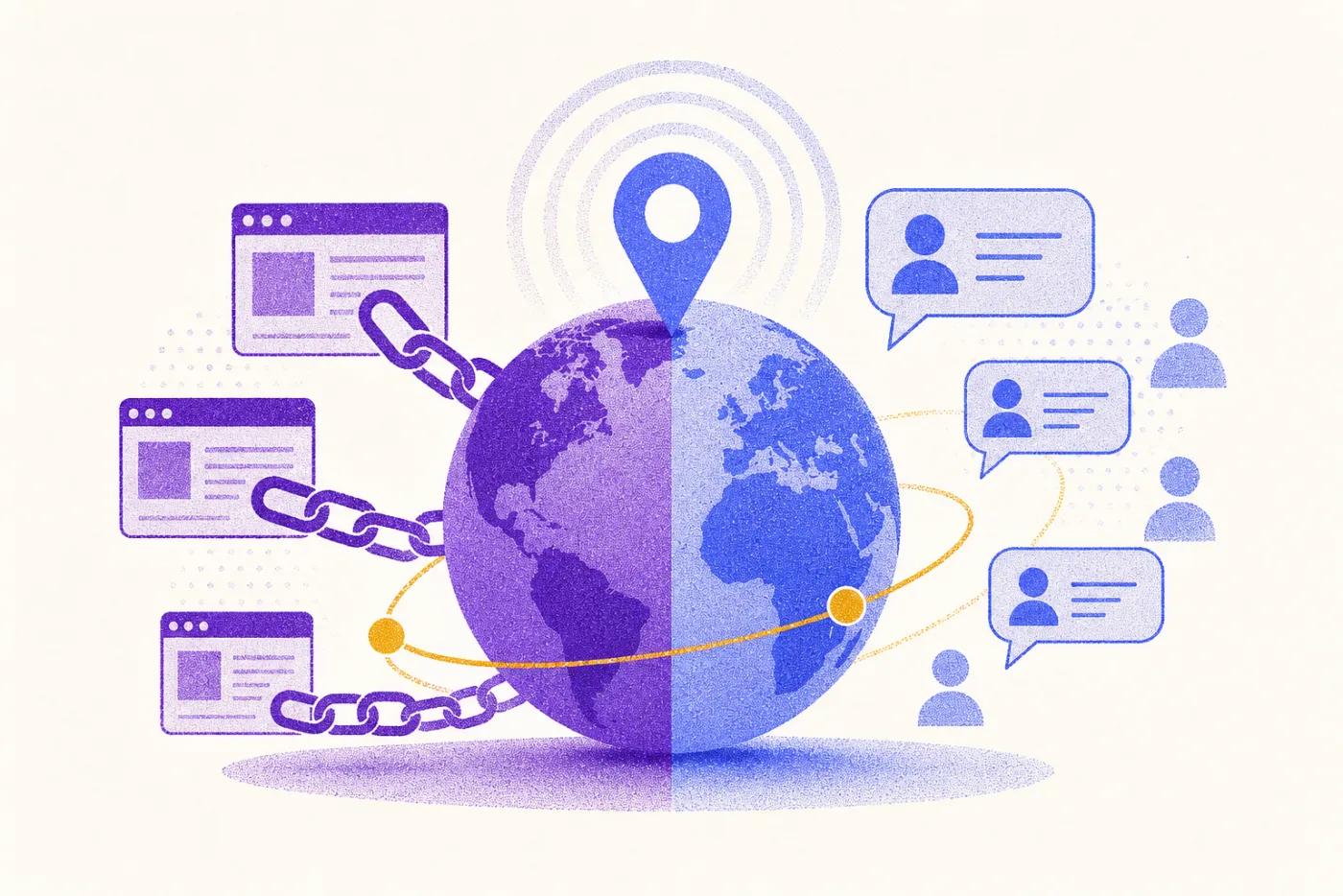
The Search Landscape Has Split in Two
Search used to be one channel. Now it's two - and they run on completely different rules.
On one side, you have traditional Google search: a link-based system where PageRank, domain authority, and backlinks determine who ranks. On the other, you have AI-generated answers from ChatGPT, Perplexity, Google AI Overviews, and Claude - systems that decide who gets cited based on a brand's broader footprint across the web.
The signals that win in one channel don't automatically win in the other. That gap is widening fast.
The numbers make the stakes clear.
Gartner predicted traditional search volume would drop 25% by 2026 as AI chatbots capture query share. ChatGPT alone now processes 2.5 billion prompts per day, according to OpenAI. AI-referred sessions jumped 527% between January and May 2025, per Previsible data reported by Search Engine Land.
The cost of being absent from AI answers is real. When a Google AI Overview appears, organic CTR drops 61% for brands not cited inside it. But brands that are cited see 35% more organic clicks than their uncited competitors, according to Seer Interactive's analysis of 25 million impressions. Being in the answer isn't a vanity metric - it's where the clicks are going.
Most brands aren't in those answers at all. Ahrefs studied 75,000 brands and found that 26% have zero mentions in AI Overviews. Invisible in the fastest-growing discovery channel in search history.
So what separates the brands that get cited from those that don't?
It comes down to two distinct signals: backlinks, which still power classic SEO rankings, and brand mentions, which increasingly determine AI visibility. They're not interchangeable, don't always come from the same sources, and building one doesn't guarantee the other.
This article breaks down how each signal works, where they overlap, and how to build a strategy that earns visibility in both channels - before the gap gets any wider.
Quick Comparison: Backlinks vs. Brand Mentions at a Glance
Here's the TL;DR before we get into the detail.
| Dimension | Backlinks | Brand Mentions |
|---|
| Primary channel | Google/Bing organic rankings | AI Overviews, ChatGPT, Perplexity, Claude |
| Mechanism | PageRank flow, link equity transfer, crawlability signals | Entity frequency, co-occurrence, contextual trust in LLM training data |
| Correlation with AI visibility | 0.218 | 0.664 (Ahrefs, 75K brands) |
| Correlation with Google top rankings | Very strong - the #1 result has 3.8x more backlinks than positions 2-10 (Backlinko) | Moderate (entity authority multiplier) |
| Requires a hyperlink | Yes | No |
| Primary sources | Editorial coverage, guest posts, digital PR, link-building outreach | Reviews, forums, social, news, podcasts, business profiles, comparison sites |
| Measurement tools | Ahrefs, Semrush, Moz | Ahrefs Brand Radar, Semrush AI Visibility Toolkit, Profound, brand monitoring tools |
| Time to impact | Weeks to months for ranking movement | Months for LLM training incorporation; faster for real-time retrieval (Perplexity) |
The correlation gap is the number that should stop you cold. Branded web mentions correlate with AI visibility at 0.664 - more than three times the correlation of backlinks at 0.218. For classic Google rankings, the relationship flips: backlinks remain the dominant signal by a wide margin.
These aren't competing strategies. They're complementary signals built for different retrieval systems. Backlinks tell Google's crawlers what to trust. Mentions tell AI systems what to cite. A brand that invests in only one is leaving half the search landscape uncovered.
What Are Backlinks and Why Do They Still Power Classic SEO?
Think of a backlink as a public endorsement. When one website links to another, it's casting a vote - and Google has been counting those votes since Larry Page and Sergey Brin built PageRank in the late 1990s. Each link passes a portion of the linking page's authority to the destination. The more authoritative the source, the heavier the vote.
Anchor text adds another layer. The words used in a hyperlink tell Google something about the semantic relationship between the two pages - which is why a link saying "enterprise content strategy" carries different weight than one saying "click here."
The numbers still make a compelling case for backlinks in classic SEO:
- Backlinko's analysis of 11.8 million Google results found the #1 ranking page has 3.8x more backlinks than pages in positions 2-10
- Semrush's 2024 Ranking Factors Study confirmed that backlink signals - referring domain count, domain authority, and link relevance - remain among the strongest measurable correlations with high rankings
- Aira's State of Link Building survey found 94% of SEOs believe Google will still use links as a ranking signal five years from now
The quality threshold has shifted dramatically, though. A handful of links from DA 70+ publishers now outweigh hundreds from low-authority directories. Topical relevance matters as much as domain strength - a link from a niche industry publication often beats one from a generic news aggregator. Over-optimized, exact-match anchors can hurt as much as help.
There are four core backlink types worth knowing:
- Dofollow - passes link equity; the standard editorial link
- Nofollow - no equity transfer; Google treats it as a hint, not a directive
- rel=sponsored - flags paid placements; Google discounts these for ranking
- rel=ugc - marks user-generated content like forum posts and comments
The deeper reason Google still trusts backlinks: they're hard to fake at scale. A genuine editorial link requires a third party to deliberately point their audience somewhere. That's a real-world trust signal no algorithm can manufacture cheaply.
Here's the kicker. Google's Gary Illyes said at a search conference in April 2024 that Google "needs very few links to rank pages" - then immediately joked he shouldn't have said it. The subtext is clear: quality has completely overtaken quantity. One link from a genuinely authoritative, topically relevant source is worth more than a hundred from sites nobody reads.
The Four Types of Backlinks That Still Move Rankings
Not all backlinks are equal. A link from a dormant directory does almost nothing. A link from a major industry publication can shift your rankings in weeks. Here's what actually counts.
1. Editorial backlinks from high-authority publishers
These are earned, not bought. A journalist cites your original research. A trade publication quotes your CEO. A Backlinko study of nearly 12 million search results found that pages in the #1 spot had 3.8x more backlinks than pages ranked #2-#10. One placement in a DA 70+ outlet can deliver more authority than months of cold outreach.
2. Topically relevant contextual links
A link buried in a footer is worth far less than one embedded in the body of a relevant article. Google reads context. A link from a cybersecurity blog to your security software carries real topical weight. The same link from a cooking site? Minimal impact.
3. Digital PR links
Data-driven campaigns, original surveys, and proprietary research give journalists something worth citing. These earn editorial backlinks and brand mentions at the same time, making them the highest-ROI tactic for teams investing in both classic SEO and AI visibility. One well-executed study can generate dozens of placements.
4. Expert roundup and industry report citations
Being named in a "Top 10 Tools" list or cited in a market report builds link equity and brand recognition together. These placements also appear frequently in AI-generated answers, so they pull double duty.
What no longer works: Directory submissions, private blog network (PBN) links, and low-quality guest posts on irrelevant sites. Google's algorithms have long since discounted these, and they carry zero weight in AI citation patterns either.
What Are Brand Mentions and Why Do They Power GEO?
A brand mention is any online reference to your brand, product, or leadership figure. It doesn't need a hyperlink to count. That's the part most SEO teams miss.
There are six types worth knowing:
- Linked mentions - traditional backlinks where your brand name anchors a hyperlink
- Unlinked mentions - your brand name appears in text, but no link is attached
- Implied mentions - references to concepts closely associated with your brand, without naming you directly
- Direct mentions - explicit brand name or social tag
- Visual mentions - your logo or product appears in an image
- Earned mentions - unpaid, third-party discussions in reviews, forums, or press coverage
In classic SEO, only linked mentions carry real weight. In GEO, the picture is completely different.
Why LLMs Learn From Words, Not Links
Here's the mechanistic insight most articles skip: Large Language Models aren't trained on hyperlink graphs. They're trained on text.
As Ryan Law, Director of Content Marketing at Ahrefs, puts it:
> "LLMs derive their understanding of a brand's authority from words on the page, from the prevalence of particular words, the co-occurrence of different terms and topics, and the context in which those words are used."
PageRank follows links. LLMs follow language. That's why a brand mentioned frequently and positively across forums, review sites, trade publications, and news articles builds AI authority, even when none of those mentions include a hyperlink. The more often your brand name co-occurs with a topic or quality signal in the training corpus, the more confidently an AI model associates you with that space.
The Data That Proves It
Ahrefs studied 75,000 brands to identify which signals best predict inclusion in Google's AI Overviews. The results are striking:
- Brand web mentions: 0.664 correlation with AI Overview visibility
- Brand anchors: 0.527
- Brand search volume: 0.392
- Domain Rating: 0.326
- Referring domains: 0.295
- Backlinks: 0.218
The top three correlations are all off-site factors. Backlinks, the backbone of traditional SEO, rank last. Brands earning the most web mentions receive up to 10x more AI Overview citations than the next closest quartile. And 26% of brands studied had zero mentions in AI Overviews entirely.
The pattern holds across AI platforms. Kevin Indig's research found that brand search volume is the biggest predictor of visibility in ChatGPT, with a correlation of 0.334. Brands people actively search for are brands AI systems have learned to trust.
Google's 'Implied Links' Patent Changes the SEO Picture Too
This isn't purely a GEO story. Google's 'implied links' patent, which resurfaced in August 2024, describes how search engines can treat brand references as trust signals even without a traditional hyperlink. Unlinked mentions now contribute to a brand's entity profile in both classic search and AI-generated results.
The practical upshot: a press mention without a link, a Reddit thread discussing your product, a review on a third-party platform - these all feed the same machine. They shape how both Google and AI assistants understand who you are and what you're known for.
The Six Sources of Brand Mentions That AI Systems Trust Most
Not all mentions are equal. AI systems don't just count references to your brand. They weight them by source credibility, structure, and recency. Here are the six source types that carry the most GEO signal right now.
1. Review platforms (G2, Capterra, Trustpilot)
For B2B SaaS brands, this is the highest-priority channel. G2's own data shows its AI visibility score more than doubled from 6.3% to 14.9% between August and October 2025, putting it ahead of Microsoft, HubSpot, and Salesforce. According to Profound, between 33% and 75% of all review-site citations across ChatGPT, Google AI Overviews, and Perplexity come from G2 alone. Trustpilot isn't far behind: technology.org reported a 1,490% year-on-year surge in AI-driven click-throughs in 2025, making it the fifth most-cited domain on ChatGPT.
How to earn it: Build a complete profile, actively solicit reviews, and respond to them. Review velocity matters , stale profiles get deprioritized.
2. Community forums (Reddit, Quora)
Reddit is the single most-cited social source across generative AI engines. Profound's analysis of 30 million citations found Reddit accounts for 46.7% of Perplexity's top citations, and Google AI Overviews cite Reddit in roughly 21% of results.
How to earn it: Participate authentically in relevant subreddits. Answer questions where your product genuinely helps. Forced promotion gets flagged; real helpfulness gets cited.
3. Industry publications and editorial media
A mention in a respected trade publication does more GEO work than ten blog posts on your own domain. Expert articles, analyst reports, and editorial coverage from recognized outlets carry strong E-E-A-T signals that all major AI platforms weight heavily.
How to earn it: Pitch bylines, contribute expert commentary, and build relationships with journalists covering your category.
4. Comparison and 'best of' listicles
"Top 10" and "Best X for Y" content gets cited by AI because it synthesizes category-level information efficiently. Being included in these lists on third-party sites is one of the fastest GEO wins available.
How to earn it: Find the listicles that already rank and get cited in your category. Reach out to authors with updated product information and review evidence.
5. Business profiles and directories
Google Business Profile, LinkedIn company page, Crunchbase, Wikipedia (where applicable), and industry-specific directories give AI systems structured data to verify your brand as a real, legitimate entity. These are the signals that help AI resolve who you are.
How to earn it: Keep every profile complete, consistent, and current. NAP consistency (name, address, phone) matters even for B2B brands.
6. Podcasts, webinars, and social mentions
As AI platforms increasingly index multimedia content, a guest appearance on a respected industry podcast or a cited webinar can generate GEO signal that text alone can't replicate.
How to earn it: Prioritize shows and platforms your buyers actually use. One well-placed appearance on a high-authority podcast beats ten on obscure channels.
Most articles treat AI search as one thing. It isn't. ChatGPT, Google AI Overviews, Perplexity, and Claude each pull from different sources, weight signals differently, and reward different types of content. If you're optimizing for "AI visibility" without knowing which platform you're targeting, you're guessing.
Here's the mechanism that ties them together: most AI platforms use Retrieval-Augmented Generation (RAG). They pull relevant external documents in real time, synthesize an answer, and cite sources at the passage level, not the page level. Here's the kicker: LLMs cite only 2-7 domains per response on average, making inclusion intensely competitive.
Google AI Overviews
AI Overviews now appear in roughly 50% of US searches and reach approximately 1.5 billion users monthly. When one appears, only 8% of users click a traditional result. Profound's data shows Reddit (21%) and YouTube (18.8%) are its top cited sources, and Ahrefs' analysis of 1.9 million citations found 76% of cited URLs also ranked in Google's organic top 10. Traditional SEO and GEO overlap more here than anywhere else.
ChatGPT
ChatGPT's training data heavily favored encyclopedic authority , Wikipedia dominates its top-source share. For live web retrieval, content structure and semantic depth matter more than raw domain authority. The result: approximately 90% of ChatGPT citations come from outside Google's top 20, meaning it runs on fundamentally different relevance signals. Semrush research found roughly 50% of ChatGPT's cited links point to business and service websites , a real opportunity for brands with well-structured, substantive content.
Perplexity
Perplexity is the recency engine. Seer Interactive's research found about 50% of Perplexity's citations come from content published in 2025 alone. Reddit accounts for 46.7% of its citations, and it repeats domains far less than Google , only 25.11% duplication versus Google's 58.49%. That low duplication rate creates genuine room for newer brands and fresher content to break through. Users who choose Perplexity also click cited links at higher rates, making it a quality traffic source worth targeting deliberately.
Claude
Claude runs on Brave Search for web retrieval , not Google, not Bing. Profound's analysis found 86.7% overlap between Claude citations and Brave's top organic results, so Brave Search ranking is a leading indicator of Claude visibility. Third-party mentions on G2, Wikipedia, and editorial outlets carry extra weight because Claude cross-verifies sources heavily. The weird thing is: content that explicitly acknowledges its own limitations or trade-offs earns a 1.7x citation boost , intellectual honesty is a ranking signal here.
No single platform dominates all four citation pools. A diversified mention strategy , spanning review platforms, forums, editorial media, and structured business profiles , is the only way to maximize coverage across all four simultaneously.
Where Backlinks and Mentions Overlap: The Dual-Signal Sweet Spot
Here's the strategic mistake most teams make: they treat backlinks and brand mentions as an either/or choice. Build links for SEO, or build mentions for GEO. Pick one.
That's the wrong frame entirely. The highest-ROI tactics generate both signals at once.
The activities that earn editorial backlinks are exactly the activities AI systems trust most. That's not a coincidence. Both Google and AI platforms are solving the same problem: identifying credible, authoritative sources worth surfacing to users.
The five overlap zones worth your attention:
- Digital PR and earned media. A placement in a major industry publication earns a high-authority backlink (SEO signal) and a brand mention in a trusted editorial context (GEO signal). Semrush's ranking factors study found that 8 of the top 20 Google ranking factors are backlink-related, and those editorial placements are precisely the content AI systems prefer to cite. This is the single highest-leverage tactic for dual-channel visibility.
- Original research and data studies. Proprietary data, surveys, and industry reports earn citations from journalists (backlinks) and become the kind of verifiable, factual content that AI systems reach for when answering questions. When a journalist quotes your research, you earn a link. When ChatGPT answers a question about your industry, it may cite that same study.
- Expert commentary and thought leadership. Being quoted as a subject-matter expert in industry articles earns a mention, often a linked one, and builds the E-E-A-T signals that both Google and AI platforms reward. It's one of the few tactics that directly signals human expertise to an algorithm.
- Comparison and category content on third-party sites. Being included in "Best X" lists on authoritative sites earns a backlink and positions your brand in exactly the type of content AI systems cite most when users ask for recommendations.
- Review platform presence. Reviews on G2 or Capterra don't pass traditional link equity, but they create structured, third-party validation that AI systems use to verify brand legitimacy. The review platform itself often links to your site as a bonus.
Underpinning all of this is entity authority. When Google identifies your brand as a recognized entity in its Knowledge Graph, it connects mentions across the web to build a comprehensive authority picture. Two pages with similar content and similar backlink profiles rank very differently if one belongs to a recognized entity with strong brand signals. Entity authority acts as a multiplier on everything else you do in SEO.
Stop planning separate link-building and mention-building campaigns. Plan campaigns that earn both.
How to Build a Dual-Channel Investment Strategy
Most teams don't fail at SEO or GEO because they picked the wrong tactic. They fail because they tried to do everything at once and ended up doing nothing well.
Start with a diagnostic question: where is your brand weakest right now? Strong backlink profile but invisible in AI answers? Your mention strategy needs work. Good brand awareness but weak organic rankings? Your link profile needs investment. The answer shapes where you put your energy first.
Here's a three-tier framework that builds both channels without doubling your workload.
Tier 1: Foundation (Do These First , They Serve Both Channels)
- Claim and complete every business profile. Google Business Profile, LinkedIn, Crunchbase, Wikipedia where applicable, and relevant industry directories. These create the structured entity signals that Google's Knowledge Graph and AI systems use to verify your brand actually exists. Free, fast, and foundational.
- Build a review platform presence. Create and actively manage profiles on G2, Capterra, and Trustpilot. Encourage customers to leave detailed, specific reviews , not just star ratings. According to Profound data cited by G2, G2 accounts for 33% of review-site citations in ChatGPT and Google AI Overviews, and up to 75% in Perplexity. That's not a nice-to-have; it's a citation channel.
- Publish original research. A single annual survey or data study creates a citable asset that earns both backlinks and AI citations. It's the one content format that genuinely pulls double duty.
Tier 2: Authority Building (Ongoing, 3-6 Month Horizon)
Once your foundation is solid, shift to building the kind of third-party presence that signals expertise to both search engines and AI systems.
- Digital PR campaigns. Pitch data-driven stories to industry publications. Target DA 70+ outlets for maximum SEO impact. The editorial mentions that result also feed your GEO signal , one campaign, two returns.
- Expert positioning. Secure speaking slots, podcast appearances, and expert quote opportunities. These create unlinked mentions across trusted contexts , exactly the signal LLMs weight when deciding who to cite.
- Community participation. Contribute genuinely useful answers on Reddit, Quora, and industry forums. Reddit is the single most-cited domain across AI engines in 2026, accounting for roughly 40% of multi-engine aggregate citation frequency according to the AI Platform Citation Source Index 2026. Showing up there isn't optional anymore.
Tier 3: Amplification (Ongoing, Compounds Over Time)
- Monitor and convert unlinked mentions. Use brand monitoring tools to find unlinked mentions and request links where appropriate. You're converting a GEO signal into a dual signal , same mention, twice the value.
- Build topic cluster content. Comprehensive content clusters build topical authority for SEO while creating the depth of coverage AI systems use to verify expertise. Thin content doesn't get cited; depth does.
- Apply schema markup. Organization, FAQ, HowTo, and Article schema help both Google and AI systems parse and cite your content accurately. Google AI Overviews data shows a 2.3x citation lift for pages with structured markup.
On Resource Allocation
For most teams, a 60/40 split favoring content quality and mention-building over pure link acquisition reflects where the signal landscape sits right now. But that ratio should shift based on your competitive position. If AI answers dominate the top of your funnel, weight mentions heavier. If organic search still drives most of your pipeline, protect your link-building investment. The framework is the same , the dial just moves.
Tier 1: Foundation Tactics (Serve Both SEO and GEO)
Think of Tier 1 as laying the pipes. Without them, nothing else flows.
Claim your business profiles , and complete them properly.
Every major AI system builds its understanding of your brand from structured, third-party data. That means claiming and fully completing:
- Google Business Profile , consistent NAP (Name, Address, Phone), primary and secondary category tags, and a description written in natural brand language
- LinkedIn Company Page , industry, company size, specialties, and a link back to your website
- Crunchbase , founding date, funding history, and a clear description of what you do
- Wikipedia (if you qualify) , notability threshold applies, but a Wikipedia entry is one of the highest-trust entity signals available
- G2, Capterra, or Trustpilot , whichever fits your product category
- Industry-specific directories relevant to your vertical
Consistency across all of these is non-negotiable. Mismatched NAP data confuses AI systems and weakens your entity signal.
Build review velocity, not just review volume.
AI systems don't just count reviews , they weight recency. According to BrightLocal's 2026 Local Consumer Review Survey, 74% of consumers only consider reviews from the last 90 days. A profile with 200 reviews from 2022 reads as dormant. One with 50 reviews from the past six months reads as active and trusted.
Practical ways to build velocity: post-purchase email sequences, in-app prompts at the moment of value delivery, and customer success check-ins timed to peak satisfaction.
Create at least one proprietary research asset.
Even a 200-respondent survey on a relevant industry question gives journalists and AI systems a citable data point they can't find anywhere else. The key word is proprietary , a rehash of existing stats won't cut it. The finding has to be genuinely surprising or useful.
Once you have these assets, apply Organization schema and FAQ schema to your key pages. FAQPage schema improves AI citation rates by 30% on average, giving AI systems a clean, unambiguous signal about what your content means.
Tier 2: Authority Building Through Digital PR and Expert Positioning
This is where real compounding happens.
Digital PR is the closest thing to a dual-signal tactic available. A well-executed campaign earns an editorial backlink from a DA 70+ outlet and creates a trusted mention that AI systems pull from. The anatomy is straightforward: identify a data angle journalists in your vertical actually care about, run original research or a proprietary analysis, package it with a press release and media kit, then pitch with a personalised angle for each target publication. According to the Reporter Outreach State of Link Building 2026, 34% of SEO professionals now name digital PR their single best-performing tactic. That's nearly double the share for guest posts.
Expert quote platforms are the lower-lift version of the same play. Connectively (formerly HARO) shut down in December 2024, but Qwoted has stepped in as the primary journalist-source matching platform. Respond to relevant media requests with a sharp, specific quote and you'll typically earn a mention in a publication that AI systems already trust. Many placements include a backlink. Even when they don't, the editorial mention still feeds your GEO footprint.
Podcast appearances are underrated here. Being a guest on industry podcasts creates unlinked mentions in show notes, transcripts, and episode descriptions. That's indexed, crawlable content that adds to your brand mention ecosystem across multiple pages per episode.
Reddit is non-negotiable for Perplexity visibility. In January 2026, 24% of all Perplexity citations came from Reddit alone. Find the 3-5 subreddits most relevant to your category, contribute genuinely useful answers, and let your brand surface naturally. Promotional posts get ignored. Helpful ones get cited.
How to Measure Success in Both Channels
Here's the uncomfortable truth: most teams are measuring only half the picture. They track rankings and backlinks religiously, then wonder why their brand isn't showing up in ChatGPT or AI Overviews. SEO and GEO need different scorecards.
SEO metrics: backlink-focused
These five metrics tell you how your link profile is performing:
- Domain Rating / Domain Authority - your overall link profile strength, tracked in Ahrefs or Moz
- Referring domains - the number of unique sites linking to you (more meaningful than raw backlink count)
- Organic keyword rankings - position tracking for your target keywords in Google and Bing
- Organic traffic - sessions arriving from search engines, the clearest signal that rankings are converting
- Link velocity - the rate of new backlink acquisition. Ahrefs research found that top-ranking pages typically gain new referring domains at +5% to +14.5% per month. Staying in that range signals healthy, natural growth
GEO metrics: mention-focused
This is where most teams have a blind spot. These signals track how AI systems perceive and cite your brand:
- AI Mention Rate - how often your brand appears in AI-generated responses for target queries. Tools like Ahrefs Brand Radar, Semrush AI Visibility Toolkit, and Profound track this
- Share of Model Voice (SOMV) - your brand's citation share vs. competitors across AI platforms. Search Engine Land defines it simply: brand appearances / total AI answers generated for a prompt set
- Citation Rate - the percentage of relevant AI responses that include your brand
- Brand web mentions - total volume of brand references across the web, linked and unlinked. Ahrefs Brand Radar tracks this, and it's the single strongest correlator with AI Overview visibility (0.664 Spearman correlation)
- Branded search volume - monthly search volume for your brand name. Ahrefs' study of 75,000 brands found this correlates at 0.392 with AI Overview visibility
- Review velocity - new reviews per month on G2, Capterra, and Trustpilot
- Sentiment in AI responses - whether AI mentions your brand positively, neutrally, or negatively
Dual-channel metrics that serve both
- Branded traffic - organic sessions from branded keywords. It's a weaker proxy (0.274 correlation with AI mentions), but still a useful indicator of brand awareness building
- Entity recognition - whether your brand has a Google Knowledge Panel. This signals that Google has established your brand as a known entity
The measurement gap you need to close
GEO measurement is still maturing. Most tools track citation frequency but not business impact. That's a real limitation.
The practical fix: establish a baseline measurement cadence now. Query your target keywords in each major AI platform weekly. Track whether your brand appears, in what context, and with what sentiment. It's manual, but it's the most honest signal you have until the tooling catches up.
The Verdict: Which Signal Should You Prioritize?
"It depends" is a non-answer. Here's the actual verdict, broken down by where your brand sits right now.
Scenario 1: New domain or early-stage brand
Without foundational link equity, you won't rank in Google. And without Google rankings, you're far less likely to appear in AI Overviews, which frequently pull from top-10 organic results. Build links first. Claim every business profile and start seeding review platform presence in parallel, but don't split your attention evenly.
- Recommended ratio: 70% link-building, 30% mention-building
Scenario 2: Established brand with strong Google rankings but low AI visibility
Your backlink foundation is solid. The problem is off-site presence. Ahrefs' study of 75,000 brands found brand web mentions carry a 0.664 correlation with AI Overview visibility, compared to just 0.218 for backlinks. That gap is the gap in your strategy. Shift investment toward digital PR for editorial mentions, review platform optimisation, community participation, and original research.
- Recommended ratio: 30% link-building, 70% mention-building
Scenario 3: Strong brand awareness but weak rankings
You have mentions but lack the structural link equity to rank competitively. People know your name; Google doesn't trust your domain yet. Invest in targeted link acquisition through digital PR and expert content that earns links from authoritative publications.
- Recommended ratio: 60% link-building, 40% mention-building
Scenario 4: Competitive category with strong incumbents
You need both at scale. The highest-ROI move is tactics that serve both channels at once. Original research is the single best investment here. It earns editorial backlinks, creates citable content for AI systems, and builds topical authority that compounds over time.
- Recommended ratio: 50/50, focused on dual-signal tactics
The overarching verdict
The brands that dominate both Google and AI search in 2026 aren't choosing between backlinks and mentions. They're treating both as complementary infrastructure. Backlinks build the structural authority that gets you ranked. Mentions build the distributed presence that gets you cited.
The signal landscape has split. Your strategy needs to match it.
Frequently Asked Questions
Are backlinks still important for SEO in 2026?
Yes. Backlinks remain one of Google's core ranking signals. Elementor's analysis of 1 million keywords found that referring domain count still correlates at 0.255 with rankings, and 75% of pages cited in Google's AI Overviews rank in the top 12 organic results. Quality and topical relevance matter far more than volume, but backlinks aren't going anywhere.
Do unlinked brand mentions help with SEO or GEO?
For classic SEO, unlinked mentions carry less direct weight than backlinks, though Backlinko notes Google likely treats them as a brand signal. For GEO, they're critical. Ahrefs' study of 75,000 brands found brand mentions correlate with AI visibility at 0.664, compared to just 0.218 for backlinks. In AI search, being talked about matters as much as being linked to.
What's the difference between SEO and GEO?
SEO (Search Engine Optimization) focuses on ranking in traditional search results, where backlinks, keywords, and on-page signals drive position. GEO (Generative Engine Optimization) focuses on appearing in AI-generated answers from tools like ChatGPT, Perplexity, and Google AI Overviews. GEO relies more on consistent brand mentions, third-party reviews, and entity recognition across trusted sources.
Can you rank in AI search without backlinks?
It's possible, but harder. AI systems pull from sources that already rank well organically, so a strong backlink profile creates an indirect pathway to AI citations. That said, brands with high mention frequency across forums, review sites, and industry publications can earn AI visibility even without a dominant backlink profile.
Which signal should I prioritize: backlinks or brand mentions?
Neither alone is enough. Backlinks protect and build your organic search rankings. Brand mentions, reviews, and third-party presence build your AI search visibility. The strongest strategy invests in both: earn editorial backlinks through digital PR and expert content, while actively building your presence on review platforms, directories, and community sites where AI systems look for corroboration.
How do I know if my brand is being cited by AI tools?
Search for your brand name and key product categories directly in ChatGPT, Perplexity, and Google AI Overviews. Track whether you appear in responses, and note which sources AI cites when it does mention you. Those cited sources are your highest-priority targets for future mentions and backlinks.
Conclusion
Backlinks still win Google rankings. Brand mentions win AI citations. The good news: the tactics that earn editorial placements in high-authority publications tend to serve both channels simultaneously. Build for one, and you'll often get credit in the other.
Publish Content That Ranks in Google and Gets Cited by AI
Content Pipeline by Content Pipeline plans, writes, and optimizes content for both SEO and GEO - with built-in keyword research, live SERP analysis, FAQ and schema markup, and one-click publishing to your CMS. Stop choosing between Google rankings and AI citations.
See Content Pipeline in Action
See the Content Pipeline platform, explore SEO and GEO, or compare us in AirOps alternatives.
Sources
- Gartner Predicts Search Engine Volume Will Drop 25% by ...
- ChatGPT users send 2.5 billion prompts a day
- AI traffic is up 527%. SEO is being rewritten.
- 26 AI SEO Statistics for 2026 + Insights They Reveal
- Google AI Overviews drive 61% drop in organic CTR, 68% ...
- An Analysis of AI Overview Brand Visibility Factors (75K ...
- Top Brand Visibility Factors in ChatGPT, AI Mode, and AI ...
- We Analyzed 11.8 Million Google Search Results. Here's ...
- Ranking Factors Semrush Study
- Google's 200 Ranking Factors: The Complete List (2026) - Backlinko
- The Impact of Link Building - Aira
- Google Confirms Links Are Not That Important
- We Studied the Impact of AI Search on SEO Traffic
- The Most-Cited Domains in AI: A 3-Month Study
- What content works well in LLMs? - by Kevin Indig
- AI Visibility: What ChatGPT, Google AI, and Perplexity Cite Most
- Profound x G2: Turning AI Search into a performance channel
- YouTube Overtakes Reddit as the #1 Social Source for AI ...
- Trustpilot Profit Quadruples on AI Search Boom
- AI Platform Citation Source Index 2026 , The 50 Websites ...
- Does G2 Get Ranked in AI LLM Search?
- 50 AI Overviews Statistics 2026 (Latest Data & Reports)
- The 5W Citation Source Audit - Q1 2026 - 5W Public Relations
- How ChatGPT and AI Are Changing SEO in 2026
- AI Platform Citation Patterns: How ChatGPT, Google ...
- Mastering AI Citations: The Ultimate GEO Playbook
- Google AI Overviews Statistics (2026): 56+ Data Points on ...
- Study: AI Brand Visibility and Content Recency
- 76% of AI Overview Citations Pull From the Top 10
- Structured Data AI Search: Schema Markup Guide (2026)
- Local Consumer Review Survey 2026: Star Ratings Keep ...
- Qwoted - Connecting the Media with Expert Sources
- State of Link Building 2026: A Survey of 500 SEO Pros
- How Many New Backlinks Do Top-ranking Pages Get Over ...
- 8 GEO metrics to track in 2026
 By Deon Malan · SEO & GEO Strategist ·