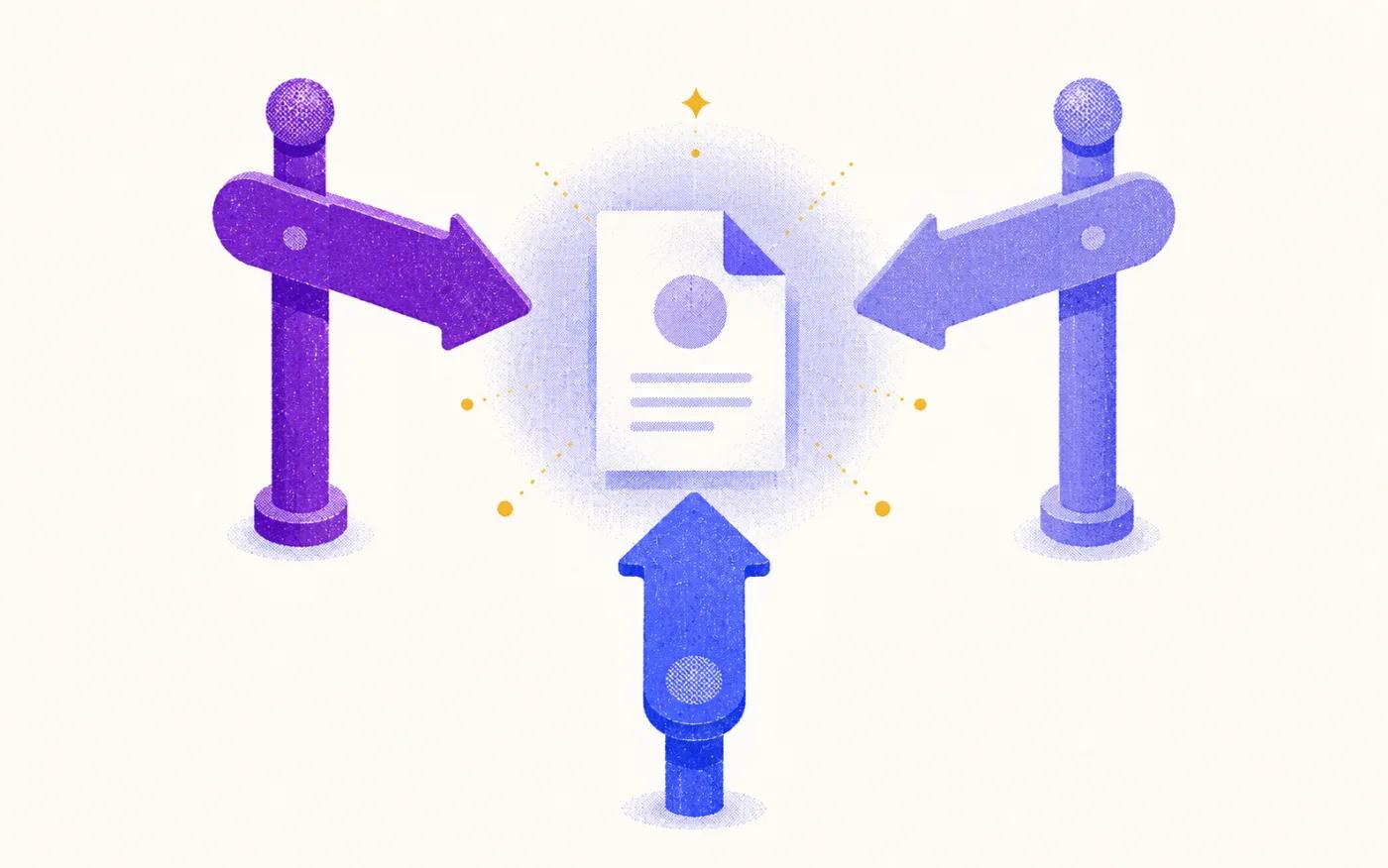
The Search Landscape Has Split in Three
Search used to be one channel. Now it's three, and they work very differently.
Type "best project management software" into Google today and you'll hit at least two distinct experiences before you reach a single blue link: a ranked list of articles and review pages (SEO), and an AI Overview summarising the top picks directly on the SERP (AEO). Then open ChatGPT and ask the exact same question. You'll get a confident, sourced answer that never touched Google at all (GEO). Same user, same intent, three completely separate discovery surfaces.
This isn't a future scenario. It's already the default for millions of searches every day.
Gartner predicted in 2024 that traditional search engine volume would drop 25% by 2026 as AI chatbots absorb more queries. EMARKETER, analysing Comscore data from August 2025, found that generative AI engines already account for 3.3% of online discovery time in the US.
That might sound small. Here's the kicker: organic search still dominates actual referral traffic. Conductor's 2026 AEO/GEO Benchmarks Report, which analysed 3.3 billion sessions across 13,770 domains, found AI referral traffic sits at just 1.08% while organic search delivers 53% of all website visits.
So why does this matter right now?
Traffic numbers don't capture awareness. A user who asks ChatGPT which vendors to shortlist and never sees your brand has already made a decision before they ever open a browser tab. Brands absent from AI answers lose consideration at the very top of the funnel, silently, with no ranking drop to alert them.
The gap between SEO and AI channels will close faster than most teams are prepared for. The brands building AI visibility now are buying time.
This guide covers what you need to act: precise definitions of SEO, AEO, and GEO; where they overlap and where they diverge; and a practical unified playbook for doing all three without rebuilding your content operation from scratch.
Quick Definitions: SEO, AEO, and GEO at a Glance
Three terms. Endless confusion. Here's what each one actually means.
SEO (Search Engine Optimization) is the practice of optimizing your content, technical infrastructure, and authority signals so your pages rank in traditional search engine results pages (SERPs) like Google and Bing. It's the oldest of the three disciplines and still the foundation everything else is built on.
AEO (Answer Engine Optimization) is structuring content to be selected as the direct answer in featured snippets, knowledge panels, voice assistant responses, and Google AI Overviews. These are zero-click surfaces: the answer appears without requiring a click. AEO predates generative AI but has been repurposed for it.
GEO (Generative Engine Optimization) is creating authoritative, citation-worthy content that AI systems like ChatGPT, Claude, Perplexity, and Google Gemini choose to reference when synthesizing conversational responses. The term was formally defined in November 2023 by Princeton University researchers, making it the newest of the three.
You'll also hear LLMO (Large Language Model Optimization), which overlaps heavily with GEO. The difference is mostly origin: GEO came from academia, LLMO from practitioners. As Onely puts it, AI SEO is the umbrella term for all three combined.
The terminology confusion is real, and it's not your fault. 37% of SEO professionals admit they don't know how to use AI tools, while 73% of agency leaders acknowledge AI has radically changed search. The industry is still catching up to its own vocabulary.
These aren't competing strategies. They're three layers of the same visibility stack.
SEO: The Foundation That Still Drives 53% of Traffic
Organic search is unglamorous. It's also responsible for 53% of all website traffic, which makes it impossible to ignore.
SEO targets one thing: ranking in traditional search engine results pages. That means earning blue links through Google's 200+ ranking signals, which break down into three core pillars:
- Technical SEO - crawlability, Core Web Vitals, site architecture, and indexation
- On-page SEO - keyword targeting, heading hierarchy, internal linking, and content depth
- Off-page SEO - backlinks, brand authority, and E-E-A-T signals (Experience, Expertise, Authoritativeness, Trustworthiness)
Weaken any one pillar and the whole thing wobbles.
The Paradox: More Visibility, Fewer Clicks
Here's where it gets counterintuitive. Google search isn't dying - it's growing. BrightEdge found that total search impressions increased by over 49% since AI Overviews launched in May 2024. More people are searching than ever.
But they're clicking less. CTRs dropped nearly 30% over the same period. Ahrefs analysed 300,000 keywords and found that when an AI Overview appears, position-1 CTR falls by 34.5%.
More visibility. Fewer clicks. That's the SEO paradox of 2025.
AI Overviews now appear in over 11% of Google queries according to BrightEdge, with some query categories hitting 60% trigger rates. You can rank #1 and still watch traffic evaporate because Google answered the question before anyone clicked through.
What SEO Still Does Well
Conductor's 2025 State of SEO report found that 91% of marketers say SEO positively impacted their website performance and marketing goals in 2024. Organic search still converts at rates paid channels can't match, and it compounds over time in a way that ad spend never does.
The shift is in how you approach it. Individual keyword targeting is giving way to topical authority: building clusters of content that signal deep expertise on a subject rather than chasing isolated rankings. E-E-A-T has become the connective tissue. Google wants to see real experience, genuine expertise, and a credible brand behind the content.
What SEO Can't Do
SEO gets you into Google's blue links. It does nothing for ChatGPT responses, Perplexity citations, or voice assistant answers. A user asking their AI assistant for a software recommendation won't see your #1 ranking. They'll see whoever the AI decided to trust.
That gap is exactly why AEO and GEO exist, and why SEO alone is no longer enough.
Core SEO Signals That Still Matter in 2025
Five signals separate sites that hold their rankings from those quietly bleeding traffic.
Topical authority over isolated keyword pages. Google rewards sites that own a topic, not just a URL. Build pillar pages that cover a subject at a high level, then support them with cluster content that goes deep on subtopics. Every cluster page links back to the pillar; the pillar links out to each cluster. This site graph tells Google and AI systems exactly how your content relates.
E-E-A-T: the signal that crosses all three disciplines. Experience, Expertise, Authoritativeness, Trustworthiness. Google's Search Quality Rater Guidelines expanded to 182 pages in September 2025, with E-E-A-T as the central quality lens. In practice: add author bios with verifiable credentials, link to LinkedIn profiles, cite reputable sources inline, and publish original research. This isn't just an SEO play. It's the same foundation that gets you cited in AI answers.
Technical health: the floor, not the ceiling. Core Web Vitals (especially INP, which replaced FID in 2024), mobile-first indexing, structured data markup, and crawl budget hygiene keep your content eligible to rank. A slow, poorly structured page won't get far regardless of how good the writing is.
Internal linking as a content map. A well-linked site helps both Google and AI crawlers understand which pages are authoritative and how concepts connect. Thin internal linking leaves PageRank stranded on pages that deserve it.
Backlink quality over quantity. First Page Sage's Q1 2025 analysis puts backlinks at roughly 13% of algorithm weight, down from over 50% historically. One citation from a respected industry publication beats fifty directory links.
Four actions to take this week:
- Audit your top 10 pages for author bio completeness and credential links
- Map your pillar-cluster structure and fix any orphaned supporting pages
- Run a Core Web Vitals check in Google Search Console and flag INP failures
- Identify three high-authority publications in your niche for a targeted outreach list
AEO: Winning the Zero-Click Surfaces
Most searches never send anyone to your website. That's not a prediction - it's already happening.
SparkToro's 2026 research found that 68% of U.S. Google searches ended without a click in the first four months of 2026, up from 60% in 2024. Users got their answer and moved on. Answer Engine Optimization (AEO) is the discipline built for exactly this reality.
AEO targets the surfaces where Google extracts and displays answers directly, rather than listing links for users to follow:
- Featured snippets (paragraph, list, and table formats)
- People Also Ask boxes
- Knowledge panels
- Voice assistant responses (Google Assistant, Siri, Alexa)
- Google AI Overviews
Where SEO competes for a ranked position among ten blue links, AEO competes to be the single extracted answer: the one result Google or a voice assistant reads aloud or surfaces at the top of the page.
The content format shifts accordingly. SEO rewards depth and authority across thousands of words. AEO rewards concise, direct Q&A pairs that answer a specific question in one tight paragraph or a clean list. The average traditional search query is 3.37 words; AEO targets longer, conversational queries of four or more words that signal a user wants a direct answer, not a list of options.
Voice search makes this more urgent. Ringly.io's 2026 analysis projects 157.1 million U.S. voice assistant users by 2026, and voice queries are almost always phrased as full questions - the exact format AEO content is built to answer.
Here's the kicker: AEO still matters even when it doesn't drive clicks. Brand visibility in zero-click surfaces builds recognition. TNGShopper's 2025 data shows early AEO adopters capturing 3.4x more traffic from AI search than competitors who waited.
Google AI Overviews sit at the boundary between AEO and GEO. They appear inside the Google SERP, making them an AEO surface, but they're generated by AI, which means the optimization logic starts to look a lot like GEO. That overlap isn't a problem to solve. It's a signal that the two disciplines are converging, and content strategies that serve one increasingly serve both.
AEO Tactics: How to Structure Content for Direct Answers
Most content is written to be read. AEO content is written to be extracted. That's a different job entirely.
Here's the playbook:
1. Question-first structure. Use the question as your H2 or H3 heading, then answer it in the very first paragraph, in 40-60 words, before you elaborate. Answer engines pull that opening passage directly. If your answer is buried in paragraph four, it won't get pulled.
2. Schema markup. FAQPage schema tells answer engines which content is structured as a direct Q&A. HowTo schema signals step-by-step processes. QAPage schema works for community-style answers. Speakable schema flags content for voice assistants. Think of schema as a label on a filing cabinet: it tells the system exactly where to look.
3. Featured snippet formatting. Search Engine Land confirms PAA answers average 40-50 words. For list snippets, keep items to eight or fewer with clear, parallel labels. For comparison content, use proper HTML table markup. It's underused and gives you a structural edge.
4. Conversational language. Write answer paragraphs the way someone would ask a question out loud. Use "you" and "your." Drop the jargon. Voice queries are natural language, so your answers should be too.
5. One-sentence definitions. Every key term needs a standalone definition that can be lifted as a direct answer without surrounding context.
6. PAA targeting. Research the People Also Ask boxes for your target queries using tools like AlsoAsked or Semrush. Then build dedicated H3 sections that answer each one directly.
Before (generic paragraph): > "Answer engine optimization is an important strategy that businesses should consider when thinking about their digital presence and how users find information online."
After (AEO-optimized): > What is answer engine optimization? > Answer engine optimization (AEO) is the practice of structuring content so AI assistants and search engines can extract and surface it as a direct answer to a user's question, without requiring a click.
The after version has a question heading, a 35-word extractable definition, and zero filler. That's what gets pulled.
GEO: Getting Cited by ChatGPT, Perplexity, and Gemini
Most marketers are optimizing for a search results page that fewer people are actually looking at.
Generative Engine Optimization (GEO) is the practice of making your brand visible inside AI-generated answers, not just on a results page. When someone asks ChatGPT to recommend a project management tool, or asks Perplexity to explain a compliance concept, GEO determines whether your brand gets named or ignored.
The AI search market is already concentrated. First Page Sage puts ChatGPT at 59.7% AI market share, followed by Microsoft Copilot (14.4%), Google Gemini (13.5%), Perplexity (6.2%), and Claude (3.2%). On referral traffic, ChatGPT's lead is even sharper: Conductor's analysis found it drives 87.4% of all AI referrals to websites across industries.
GEO works nothing like SEO or AEO. There are no positions to rank for. No page one. AI systems read across hundreds of sources, synthesize an answer, and choose which sources to credit based on perceived authority, clarity, and relevance. Your success metric isn't a ranking or a click-through rate. It's whether your brand gets mentioned at all.
The opportunity is growing fast. IntelMarketResearch values the GEO market at $1.01B in 2025, projecting $17.02B by 2034 at a 45.5% CAGR. Awareness sits at 84%, with 42% of marketers already acting on it, and search interest in the term grew 121% quarter-over-quarter, according to Search Engine Land.
So what does AI actually cite? Profound's analysis of hundreds of millions of citations shows a clear pattern: ChatGPT heavily favors Wikipedia (nearly 48% of its top-source citations), established publications, and sources with clear authorship. Perplexity leans toward Reddit and community-driven content. Google AI Overviews spread citations more evenly across professional and social platforms. Here's the kicker: citation patterns can shift dramatically within weeks, making GEO a channel that rewards consistent presence, not one-time optimization.
One more thing worth knowing: the queries flowing into AI tools skew heavily informational. Semrush's clickstream analysis of 80M+ records found that 52.2% of ChatGPT prompts carry informational intent, compared to 49.6% navigational intent on Google. Your top-of-funnel explainers, guides, and definitions are exactly what AI engines are hungry for. If they're not structured to be cited, they're invisible.
GEO Tactics: How to Become a Source AI Engines Trust
Most brands assume they'll get cited by AI engines the same way they rank on Google. They won't. AI citation is a different game, and the rules are worth knowing before you spend a single hour on content.
Here's what actually moves the needle:
1. Go deep, not wide
AI engines favor sources that cover a topic exhaustively. Thin, surface-level content rarely gets cited. Build topic clusters where pillar pages link to supporting pages, signaling that your site owns a subject area, not just a single post.
2. Produce original data and proprietary insights
This is the biggest differentiator in GEO. AI engines actively seek information gain: original research, surveys, case studies, and first-party data that can't be found anywhere else. As Contadu puts it, "the winning formula is using AI to assist human experts, not replace them." A human expert's original take is exactly what AI engines can't synthesize from existing sources.
3. Make authorship visible and verifiable
Named authors with real credentials matter. Add author bio pages, link to LinkedIn profiles, and make expertise explicit. AI systems evaluate source credibility, and anonymous content starts at a disadvantage.
4. Cite reputable sources within your own content
AI engines treat well-cited content as more authoritative. Referencing peer-reviewed research, government data, or recognized industry reports signals that your content sits inside a trusted information ecosystem.
5. Write with semantic clarity
Use clear, unambiguous language. Define terms explicitly. Avoid metaphors and jargon in sentences that carry your core claims. AI engines parse for meaning, and vague phrasing creates extraction errors.
6. Build brand mentions across the web
PR coverage, guest posts, podcast appearances, and social mentions all build the brand signal that LLMs use to recognize authority. Perplexity, in particular, leans heavily on earned media over brand-owned content. Think of it as off-page GEO.
The payoff is real. Research on GEO techniques shows they can boost content visibility in AI-generated responses by up to 40%.
A practical first step: search your target queries in ChatGPT and Perplexity right now. Note who gets cited. Ask yourself what those sources have that yours doesn't. That gap is your GEO roadmap.
Not all AI platforms fish from the same pond. Each has distinct retrieval habits, and treating them as one channel is how you end up invisible on all of them.
ChatGPT leans heavily on established, encyclopedic sources. Wikipedia peaked at 14% of all ChatGPT citations in March 2025 before dropping back to around 7%, showing just how volatile citation patterns can be. A single model update can reshuffle your visibility overnight. ChatGPT favors comprehensive, factual content from authoritative domains. Think well-sourced long-form guides, not thin blog posts.
Perplexity behaves more like a live search engine. It crawls the web in real time for every query, which means fresh, well-structured content can earn citations within days of publishing. It skews heavily toward community-driven sources, with Reddit accounting for 46.7% of its top citations. Clear answer-first paragraphs and definitive statements perform best here.
Google AI Overviews creates the tightest loop between GEO and traditional SEO. A BrightEdge 16-month study found that 54% of AI Overview citations already rank in organic search results, up from just 32% at launch. Rank well organically, and you're far more likely to get cited in the AI answer above it.
Claude favors depth over breadth. Structured content with clear definitions and bullet points is up to 30% more likely to be cited by Claude than unstructured prose.
Platform-specific tweaks matter, but they're secondary. Content that is comprehensive, well-structured, authoritative, and properly cited travels well across all four platforms. Get the fundamentals right first, then layer in platform nuances.
SEO vs. AEO vs. GEO: Side-by-Side Comparison
Here's where most teams get confused: they treat SEO, AEO, and GEO as three separate workstreams competing for the same budget. They're not. But understanding where they differ is the first step to seeing how they fit together.
| Dimension | SEO | AEO | GEO |
|---|
| Primary target | Google/Bing SERPs | Featured snippets & AI Overviews | AI chatbot responses (ChatGPT, Perplexity, Gemini) |
| Success metric | Rankings & organic traffic | Snippet capture rate & voice selection | Brand mentions and citations in AI outputs |
| Content style | Comprehensive, keyword-optimized | Concise Q&A, direct answers | Authoritative, citation-worthy depth |
| Key tactics | Technical SEO, backlinks, internal linking | Schema markup, FAQ structure, conversational language | Original data, clear authorship, semantic clarity |
| Time to results | 3-12 months | 4-8 weeks for snippets | 2-6 months for citation patterns |
| Traffic impact today | 53% of all web traffic | Zero-click, but strong brand visibility | 1.08% of visits, but growing fast |
| Origin | 1990s | Evolved from SEO, pre-AI era | Princeton University, November 2023 |
The numbers tell an honest story. SEO still dominates on raw traffic volume. GEO's 1.08% referral share looks small today, but that figure comes from a Conductor study analyzing 3.3 billion sessions, and AI referrals grew roughly 1% month over month across every industry tracked. The direction of travel is clear.
Here's the insight that changes how you should think about this: these three disciplines aren't fighting over the same prize. A single, well-crafted piece of content, comprehensive, clearly structured, and backed by real authority, can win in all three channels at once. The differences are in emphasis and measurement, not in fundamentally different types of content. You don't need three separate content strategies. You need one strategy built with all three surfaces in mind.
The shared foundation is quality. Google's ranking algorithms, AI Overview citation logic, and ChatGPT's source selection all reward the same underlying signals: depth, credibility, clear structure, and genuine usefulness. The tactics diverge at the edges, schema markup for AEO, original data for GEO, technical health for SEO, but the core content investment pays dividends across all three.
Where SEO, AEO, and GEO Overlap (The Shared Foundation)
You don't need three separate content strategies.
SEO, AEO, and GEO share a common foundation. Invest in it once, and you're building for all three channels at the same time.
E-E-A-T is the single most important shared signal. Google uses Experience, Expertise, Authoritativeness, and Trustworthiness to rank pages. AI engines use the same signals to decide what to cite. As Search Engine Land notes, content with named authors, clear credentials, transparent sourcing, and current information is more likely to appear in AI-generated responses. The actions are identical across all three: put a real author byline on every piece, link to primary sources, and refresh content when facts change.
Topical authority multiplies your reach. A site with 20 well-linked articles covering a topic cluster signals authority to both search crawlers and AI systems. A single standalone article, no matter how good, can't compete. Depth of coverage is the signal that says "this source knows what it's talking about."
Structured content helps machines read your work. Logical heading hierarchies, short paragraphs, bullet lists, and tables don't just improve readability , they help Google's crawlers and AI systems parse and extract the right information from your pages.
Technical accessibility is table stakes. Fast load times, clean crawlability, proper schema markup, and mobile optimization benefit every channel. If a bot can't reach your page, nothing else matters.
Original insights are your differentiator. Proprietary data, first-hand case studies, and unique perspectives make content worth citing. AI systems prefer content that adds something new, not content that rehashes what's already out there.
Invest in E-E-A-T and topical authority, and you're building for all three channels at once.
The Unified Playbook: Doing All Three Without Tripling Your Workload
Here's the trap most teams fall into: they treat SEO, AEO, and GEO as three separate content programs. Three briefs, three workflows, three sets of KPIs. That's how you burn out a team and still underperform on all three.
The smarter move is a single content workflow that produces triple-duty output by design.
Step 1: Start with question-based keyword research
Tools like AnswerThePublic, Google's People Also Ask boxes, and Perplexity's related questions surface queries with both search volume (SEO) and conversational intent (AEO/GEO). A question like "how does X work" is a featured snippet target, an AI answer candidate, and a rankable page, all at once.
Step 2: Build topic clusters, not isolated articles
A pillar page plus 5-8 supporting articles does three jobs at once. It builds topical authority for SEO, gives AI engines the depth they need to cite you for GEO, and creates multiple shots at featured snippets for AEO. One cluster, three payoffs.
Step 3: Write with a 'triple-duty' structure on every article
This is where the workflow becomes a habit:
- Open with a concise, direct definition (AEO + GEO)
- Build out depth with evidence and cited sources (GEO + SEO)
- Use question-based H2/H3 headings (AEO)
- Add a FAQ section with FAQPage schema markup (AEO)
- Include internal links throughout (SEO)
- Make author credentials visible on every page (GEO)
Step 4: Add schema markup as standard, not an afterthought
FAQPage, HowTo, Article, and Author schema should be default on every content piece your team publishes. It takes 20 minutes to add and directly improves your chances of winning featured snippets and AI citations.
Step 5: Prioritize by intent
Not all content deserves equal attention across all three disciplines. According to the GEO research paper on arXiv, 52.2% of LLM queries are informational, which means top-of-funnel, educational content is your highest-priority target for GEO. Commercial and transactional content is where SEO effort pays off most directly.
Match your optimization depth to the intent:
- Informational content: Prioritize GEO and AEO signals (definitions, citations, schema, author authority)
- Commercial/transactional content: Prioritize SEO signals (backlinks, on-page optimization, conversion-focused structure)
Step 6: Measure all three channels
Use Google Search Console for organic SEO performance. Track featured snippet ownership for AEO. For GEO, run manual spot-checks in ChatGPT, Perplexity, and Gemini, or use an AI citation monitoring tool. If you're not measuring it, you can't improve it.
The goal isn't to do more work. It's to make every piece of content work harder.
The Triple-Duty Content Checklist
Run every article through this before you hit publish. Three groups, one pass.
✅ SEO Checklist
- [ ] Primary keyword appears in the H1 and within the first 100 words
- [ ] Keyword variations used in at least two H2 or H3 headings
- [ ] Internal links added to and from related cluster pages
- [ ] Meta title and description written and optimized for click-through
- [ ] All images have descriptive alt text
- [ ] Page passes Core Web Vitals (LCP, CLS, INP)
- [ ] At least one original data point, stat, or insight worth linking to
✅ AEO Checklist
- [ ] Key question answered in the first 50 words of the relevant section
- [ ] FAQPage schema added for Q&A content
- [ ] At least one list or table formatted for featured snippet extraction
- [ ] Answer paragraphs written in plain, conversational language
- [ ] HowTo schema applied to any step-by-step process content
- [ ] Speakable schema added if the content targets voice search
- [ ] People Also Ask questions addressed as dedicated H3 sections
✅ GEO Checklist
- [ ] Named author with visible credentials or bio
- [ ] At least three reputable external sources cited with inline links
- [ ] Original data, case study, or proprietary insight included
- [ ] Topic covered with enough depth that a follow-up question isn't needed
- [ ] Key terms defined clearly and without ambiguity
- [ ] Published on a domain with established topical authority in this subject area
- [ ] Brand name mentioned consistently and accurately throughout
None of these items require a separate workflow. Most take under five minutes each. The ones that get skipped most often , Speakable schema, named authors, original data , are exactly the ones that separate content that gets cited from content that gets ignored.
How to Prioritize: Which Discipline to Focus On First
Not every team should start in the same place. Where you begin depends on where your biggest visibility gap actually is.
Scenario 1: You have little or no organic traffic yet
Start with SEO. Build topical authority, fix technical issues, and establish E-E-A-T signals. Without domain credibility, your AEO and GEO efforts will fall flat. AI engines and Google's answer surfaces both pull from sources they already trust. You need to earn that trust first.
Scenario 2: You rank well but CTRs are sliding
Prioritize AEO. Ahrefs research from April 2025 found AI Overviews cut position-1 CTR by 34.5%. By February 2026, an updated Ahrefs study put that figure at 58%. If you're ranking but not getting clicked, winning the featured snippet or AI Overview box is how you claw back that visibility.
Scenario 3: Your buyers research in ChatGPT before they ever Google
Prioritize GEO. B2B software, financial services, healthcare, and complex purchases are increasingly researched via AI chat. Bain & Company's February 2025 research found 80% of consumers rely on AI-generated summaries for at least 40% of their searches. If that's your buyer's behavior, you need to be the source AI cites.
For most teams: run SEO and AEO together
They share roughly 80% of their tactics. Clear structure, strong E-E-A-T, and direct answers serve both. Then layer GEO in as a content quality upgrade, not a separate workstream. It's less about adding work and more about raising the bar on what you already publish.
Measuring Success Across All Three Channels
Here's the uncomfortable truth about measuring AEO and GEO: most of the impact is invisible to your current analytics stack.
Traditional SEO metrics are well-established. Pull organic sessions, keyword rankings, click-through rate, and impressions from Google Search Console. Track domain authority and backlink growth in Ahrefs or Semrush. These numbers are reliable, comparable, and easy to report upward.
AEO measurement is trickier. There's no single "featured snippet dashboard." Instead, you track it manually: identify your target question queries, check which ones trigger featured snippets or AI Overviews, and record whether you own them. Use Google Search Console's Performance report to monitor impression share on question-based queries. A widening gap between impressions and clicks is actually a signal you're winning zero-click surfaces, not losing traffic. Voice search visibility is harder to isolate directly, so use question-query rankings as a proxy.
GEO is the hardest to measure, and that's not a small problem.
AI engines don't send a referral tag every time they cite your content. Conductor's 2026 AEO/GEO Benchmarks Report found that AI referral traffic accounts for just 1.08% of all website visits across ten major industries. If you measure GEO impact by traffic alone, you'll conclude it doesn't matter. That's the wrong conclusion.
The real metric is AI share of voice: what percentage of relevant AI-generated answers mention your brand. Right now, only 14% of teams track AI visibility at all, according to GoodFirms' 2026 AI SEO research. That's a gap your competitors probably haven't closed yet.
For GEO tracking, you have two options:
- Manual spot-checking: Query ChatGPT, Perplexity, and Google AI Overviews weekly for your priority topics. Note when your brand or content gets cited. It's low-tech but surprisingly revealing.
- Dedicated GEO tools: Platforms like Profound and Otterly automate citation monitoring across AI engines and track brand mention share of voice over time.
For lean teams, a simple stack covers all three disciplines: Google Search Console for SEO, manual snippet tracking for AEO, and weekly AI citation spot-checks for GEO.
The north star metric for 2026 isn't traffic. It's visibility. AI responses are where brand perception forms before anyone clicks. Getting cited there is a leading indicator of future authority, not a lagging one.
Common Mistakes Teams Make With AEO and GEO
Most teams don't fail at AEO and GEO because they ignore them. They fail because they treat them as shortcuts.
Here are the mistakes that consistently kill results.
Treating AEO and GEO as replacements for SEO. Neither works without a foundation of domain authority and topical coverage. AI engines and answer engines both favor established, authoritative sources. Weak SEO means weak AEO and GEO.
Creating thin 'answer content' that wins snippets but loses GEO. Short, punchy content can capture a featured snippet. It won't get cited by ChatGPT on a complex query. You need conciseness for AEO and depth for GEO, often in the same piece.
Ignoring authorship and E-E-A-T signals. Anonymous content is penalized across all three channels. No verifiable author, no credentials, no editorial transparency? Google and AI engines will bury you. Put real names and real expertise on the page.
Optimizing for AI citation without original insights. AI engines detect and deprioritize generic, derivative content. Proprietary data, original research, and genuine expert opinion are what get cited. Rephrasing what everyone else already said won't cut it.
Measuring GEO with traffic metrics alone. According to Conductor's 2026 AEO/GEO Benchmarks Report, AI referral traffic currently accounts for just 1.08% of total web visits. Teams that abandon GEO because "it doesn't drive traffic" are making a strategic mistake. As Conductor's CEO Seth Besmertnik puts it: "AI hasn't replaced search - it's replaced your website as the first touchpoint." Measure citations and brand mentions, not just clicks.
Siloing SEO, AEO, and GEO into separate workflows. The most efficient approach is a unified content process where every piece is optimized for all three channels at once. Three separate workstreams means triple the effort for a fraction of the return.
Not updating content. AI engines favor current, accurate information. Stale content loses citations over time, quietly, with no warning.
The pattern across all seven mistakes is the same: teams treat these disciplines as tactics to bolt on, not as a coherent system to build.
The Future: Where SEO, AEO, and GEO Are Heading
The clearest signal about where search is heading? The lines between SEO, AEO, and GEO are already dissolving.
ChatGPT now surfaces clickable links alongside its answers. Google AI Overviews are simultaneously an AEO surface and a GEO challenge. Perplexity blends real-time web crawling with generative responses. The distinction between "ranking" and "being cited" is collapsing into a single question: does your content show up when someone needs an answer, wherever they're asking?
The AI search market is fragmenting fast. ChatGPT's share of generative AI traffic dropped from 86.7% to 64.5% between early 2025 and March 2026, according to AI Magicx's analysis of Similarweb data. Gemini surged from 5.7% to 21.5% over the same period. Perplexity grew 370% year-over-year. Optimizing for one AI engine is no longer a strategy. It's a single point of failure.
Voice and multimodal search add another layer. EMARKETER forecasts US voice assistant users will reach approximately 170 million by 2028, and multimodal queries combining images and text are already reshaping how people interact with AI tools. AEO for voice, where answers need to be concise, direct, and conversational, will only grow in importance.
The logical evolution is what the Digital Marketing Institute calls "Search Everywhere Optimization": building visibility across every discovery surface simultaneously, traditional search, AI engines, voice, and social. It's not a rebrand of SEO. It's a recognition that your audience is now scattered across a dozen different answer surfaces.
Here's the kicker: the GEO market alone is projected to grow from $1.01 billion in 2025 to $17.02 billion by 2034, per IntelMarketResearch. Teams building GEO competency now are getting in early on a discipline that will be table stakes within three years.
Through all of it, one truth holds: high-quality, authoritative, well-structured content wins. The channels change; the fundamentals don't.
Key Takeaways: Your SEO + AEO + GEO Action Plan
Here's what to carry into your next content planning session.
- SEO is still the foundation. Organic search drives 53% of all website traffic, and that's not collapsing overnight. Don't abandon it chasing new channels. Get the base right first.
- AEO is SEO's fastest upgrade. Adding FAQ schema, question-based headings, and tight answer paragraphs to content you've already published is the quickest win available. You're not starting from scratch, you're finishing the job.
- GEO is a long game. Build topical authority, original research, and named author credibility now. AI citations don't happen by accident; they go to sources that have earned trust over time.
- E-E-A-T is the shared currency. Invest in experience, expertise, authoritativeness, and trustworthiness once, and it pays dividends across all three channels.
- Measure differently. Track AI share of voice and featured snippet capture alongside traditional rankings. If you're only watching keyword positions, you're missing half the picture.
- One workflow, three channels. Don't build separate processes for SEO, AEO, and GEO. Apply the triple-duty checklist to every piece you publish from here on.
- The convergence is accelerating. Teams that treat these three disciplines as one integrated visibility stack will outpace those who silo them into separate teams with separate goals.
Now put it into practice, consistently, at scale.
Publish Content That Wins in Google and Gets Cited by AI
Most teams already know they need SEO, AEO, and GEO. The problem is bandwidth. Keyword research, FAQ schema, AI citation optimization, and a full content calendar is a lot for a lean team to hold together.
Content Pipeline is built for exactly this situation.
Specialist AI agents plan, write, and optimize every article for both Google rankings and AI citation, with FAQ, author, and how-to schema baked in automatically. Per-article keyword research and live SERP analysis mean every piece targets the right query. Your site graph powers automatic internal linking. One-click publishing sends finished content straight to WordPress or Webflow.
No growing the team. No empty calendar. No inconsistent voice.
The result: more on-brand content that ranks in Google, wins featured snippets, and gets cited by ChatGPT and Perplexity, shipped on schedule.
See how Content Pipeline works →
Conclusion
SEO still drives the majority of traffic. AEO captures zero-click attention on the SERP. GEO builds the authority that AI engines cite. You don't need three separate strategies - you need one well-built content workflow that covers all three. Start with strong fundamentals, add question-based structure, and include original insights with named authorship. That single approach wins across every channel.
Publish Content That Ranks in Google and Gets Cited by AI
Content Pipeline by Content Pipeline plans, writes, and optimizes your content for SEO, AEO, and GEO - then publishes it straight to your CMS. No extra headcount required.
See Content Pipeline in Action
See the Content Pipeline platform, explore SEO and GEO, or compare us in AirOps alternatives.
Sources
- The 2026 AEO / GEO Benchmarks Report - Conductor
- AI sends 1% of website traffic - and most of it is from ...
- AI Will Dominate Search, Just Not in 2026
- 2311.09735 GEO: Generative Engine Optimization
- GEO vs. AEO vs. AI SEO vs. LLMO: What These Terms ...
- Research Report The State of SEO in 2025 - Conductor
- One Year Into Google AI Overviews, BrightEdge Data ...
- AI Overviews Reduce Clicks by 34.5%
- Update: AI Overviews Reduce Clicks by 58%
- SEO Ranking Factors 2026: 14 Critical UK SEO Factors Guide
- Google zero-click searches reach 68% in early 2026: Study
- 47 voice AI statistics for 2026: market size, growth, and trends
- SEO Statistics 2025: GEO, AEO, and Search Optimization ...
- People Also Ask: The obvious opportunity most SEOs are ...
- AlsoAsked: People Also Ask keyword research tool
- Generative AI Statistics: 2025 Report
- AI Platform Citation Patterns: How ChatGPT, Google ...
- Chris Long - SEO Data Study
- Generative Engine Optimization GEO Services Market ...
- GEO 2.0: Advanced Tactics to Get Cited by ChatGPT, Perplexity ...
- Generative Engine Optimization Statistics (2026): 60+ Data ...
- ChatGPT Traffic Overtakes Wikipedia
- ChatGPT, Claude, Perplexity, and Google AI Overviews
- AI Overview Citations Now 54% from Organic Rankings
- Organic Channel Share Expands to 53.3% of Traffic
- AI SEO Statistics 2026: 35+ Verified Stats & 9 Research ...
- FAQ ( FAQPage , Question , Answer ) structured data
- Goodbye Clicks, Hello AI: Zero-Click Search Redefines ...
- AI Search Monitoring Tool: Track ChatGPT, Perplexity ...
- ChatGPT's Market Share Is Falling: What the 2026 ...
- Voice Assistants Will Gain About 30 Million US Users ...
- SEO Statistics 2026: Organic Traffic, Rankings & ROI Data
 By Deon Malan · SEO & GEO Strategist ·